Not sure where to put your feet? Your archery stance starts with feet about shoulder-width apart, target to your side. Then fine-tune from there.
This page is part of a wider set of guides on archery techniques, covering the basics of good form.
| Item | Value |
|---|---|
| General foot width | Shoulder-width apart or slightly wider |
| Open stance foot angle (one approach) | About 45 degrees to the target |
| Open stance pivot (another approach) | About 20 degrees toward the target |
| Weight split in an open stance | About 60% on the balls of the feet, 40% on the heels |
| Square stance foot spacing | Between shoulder-width and hip-width apart |
These figures come from Archery 360’s stance guide and Wales Archery’s stance guide. They are coaching rules of thumb and published advice can change, so check the source before you rely on them.
Why your archery stance matters
Your stance is how you orient your feet, hips and shoulders relative to the target. Archery 360 calls it the stable foundation of the rest of your form, and says setting it is the first step in shooting a bow.
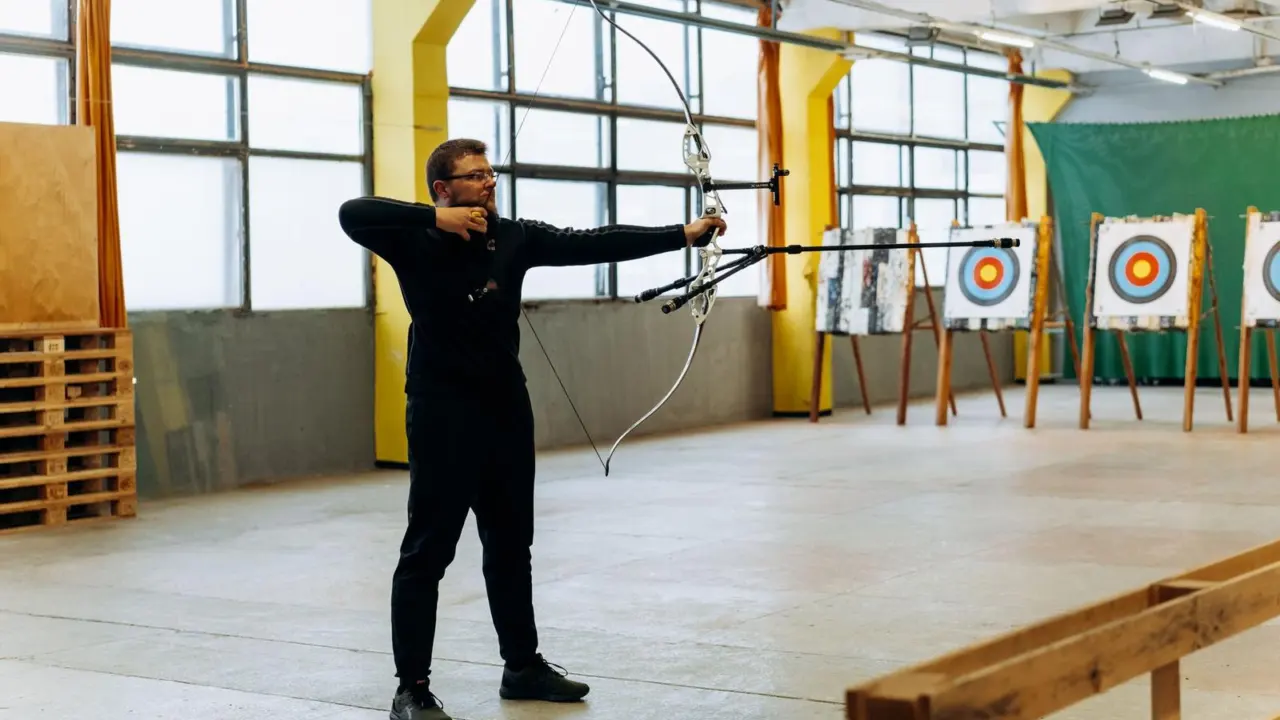
Stand with the target at your side, the way you would for a golf swing, instead of facing it. Keep your posture tall, and avoid leaning, bending or creating a hollow in your lower back.
Coach Liam Grimwood, writing in Bow International, says many archers give stance little thought. He breaks it into three key points:
- Stance direction: how you align your body to the target.
- Balance point: where your weight sits over your feet.
- Stance width: how far apart your feet are.
The sections below follow those three points, starting with direction.
Square, open and closed stances
Archery 360’s beginner form guide describes three stances you can choose from, depending on comfort and whether your bow arm has any clearance issues. Here is how each one works for a right-handed archer:
- Even (square) stance: a line across your toes points at the target. It is the most neutral option and keeps the body relatively untwisted, which makes it a great way for beginners to start.
- Open stance: your right foot steps forward, so your chest points more toward the target. Top-level archers often use it because it can create a greater sense of stability.
- Closed stance: your right foot steps back. It is the least common stance but can be useful in tricky situations, such as field archery.
Be careful with the labels, because coaches do not all use them the same way. Archery 360’s stance breakdown uses “closed” for feet that sit even with each other, while its beginner guide calls that an even stance. If you take advice from a coach, check which one they mean.
Coach Steve Ruis, writing for Glasgow Archers, starts beginners on a square stance. If they struggle to line their upper body up with the bow and target, he closes the stance roughly 10-12°.
He also notes that closed stances lengthen draws while open stances tend to shorten them. His wider point is that archery instruction has too much dogma, so treat no single stance as required.
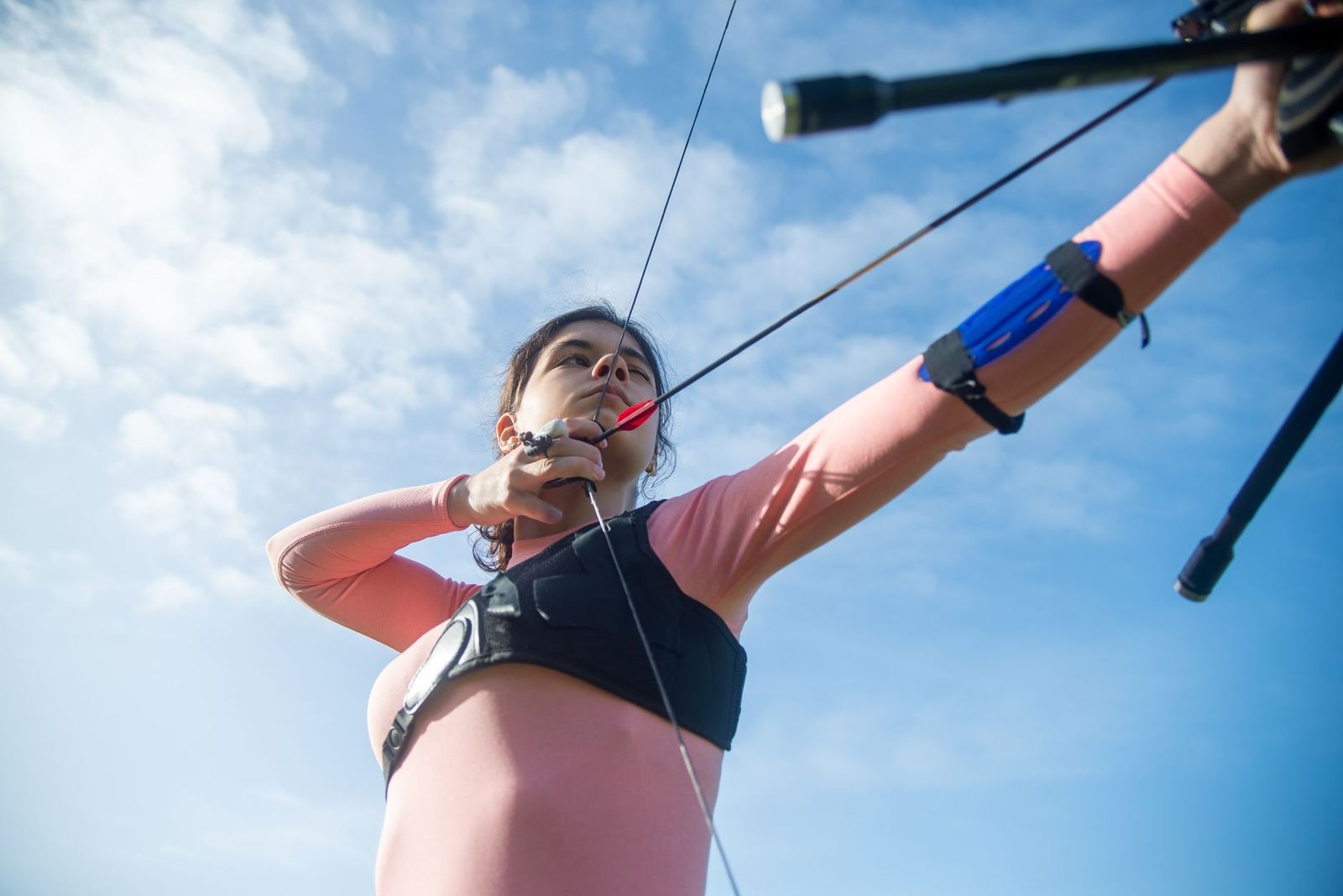
Setting your stance step by step
The easiest way to learn a stance is to start without a bow. Work through these steps and keep each one repeatable.
- Mark a shooting line. Tape the floor or lay a broom, measuring stick or taut rope in a straight line, then imagine a target line running from the middle of the target back to you.
- Place a foot on each side of the line. Wales Archery suggests spacing them between shoulder-width and hip-width apart, while Archery 360 gives shoulder-width or slightly wider as a rule of thumb.
- Start square. Line your toes up with the target line. This is simple to learn and easy to repeat indoors, outdoors or on mixed terrain.
- Try opening up if you want more stability. Bring your rear foot forward, then pivot toward the target about 20 degrees, as Wales Archery describes. Archery 360 instead sets the feet at about a 45-degree angle to the target, and says to keep your hips pointing the same way as your feet.
- Check your balance. In an open stance, Wales Archery suggests about 60% of your weight on the balls of your feet and 40% on your heels. If you can lift your toes without losing balance, you are in the right area.
- Stand tall. Keep your head over your spine and look at the target.
If your hips twist as you align your shoulders in an open stance, Archery 360 says to push down with the leg nearest the target to keep them open. Once your feet feel settled, you can move on to how to draw a bow without losing that foundation.
Fine-tuning your stance to your body
Foot position is personal, so test it rather than copying someone else’s. Bowhunter offers a simple check: draw and anchor as usual with no arrow attached, then close your eyes. Move your feet until you find the most comfortable and stable spot, open your eyes and see where the bow points.
Ruis uses a similar natural draw exercise. You draw on a target with a light bow, close your eyes, count to ten and open them. If the bow points left of the target, you move your feet in the opposite direction and repeat until you finish pointing close to where you want, as Glasgow Archers describes.
Balance matters too. Grimwood explains in Bow International that pointing your toes far out moves the balance point back toward your heels. If you sway even in calm weather, he suggests trying parallel feet.
Give any change time. Bowhunter says it takes about 30 days to establish a new habit, so change one thing at a time and stick with it. If you prefer traditional gear, the guide on how to shoot a longbow covers that style in more detail.
Wind, slopes and uneven ground
Wind is where your stance choice shows up most. Archery 360 warns that a closed stance can be less stable than an open stance, especially in high winds, while an open stance can be very stable.
Grimwood adds that standing square-on to the target leaves you open to string contact and being blown around in wind. Opening up the body brings the bow arm across and creates a bigger gap between your body and the string, which is why his advice leans toward a more open stance.
Uneven ground matters even more. Wales Archery notes that stance becomes more important in field or 3-D archery, where you shoot on uneven ground. When the terrain stops you from setting a perfect stance, Grimwood prioritises body direction first, because a body out of alignment makes good execution hard.
Frequently asked questions
Which archery stance is best for beginners?
Show answer
An even, or square, stance is a common starting point. Archery 360 calls it the most neutral option, and you can open or close it later if you need to.
How wide should my feet be?
Show answer
Shoulder-width or slightly wider is the usual rule of thumb. Grimwood rates width as probably the least important of the three stance factors, so sort out direction and balance first.
Should I set my stance the same way every shot?
Show answer
Yes. Once you find a stance that works, make a habit of setting it each time you step to the line. Archery 360 notes that top competitive archers look down and adjust their feet before they start shooting.
Why do I sway while I hold?
Show answer
Poor balance is a common cause. Grimwood links swaying in compound shooters to an incorrect stance, and suggests trying parallel feet if your toes point too far out, as Bow International reports.