Wondering which of the types of archery competitions is right for you? Most fall into target, indoor, field and 3D, plus a few specialist formats. Choose by where you want to shoot and whether distances are known.
Where these formats are shot depends on local groups, so the overview of archery clubs is a good next step.
| Item | Value |
|---|---|
| Outdoor target distance, recurve (international events) | 70 metres |
| Outdoor target distance, compound (international events) | 50 metres |
| Indoor target distance (typical) | 18 metres |
| Field archery target distances (international rounds) | 5 to 60 metres |
| Field and 3D qualification (2018 guide) | Two 24-target rounds |
| Indoor season (usual) | October to March |
The figures come from the World Archery disciplines page and the World Archery Field and 3D competition guide. Figures can change, so check the source before you rely on them.
Target archery: the format most people picture
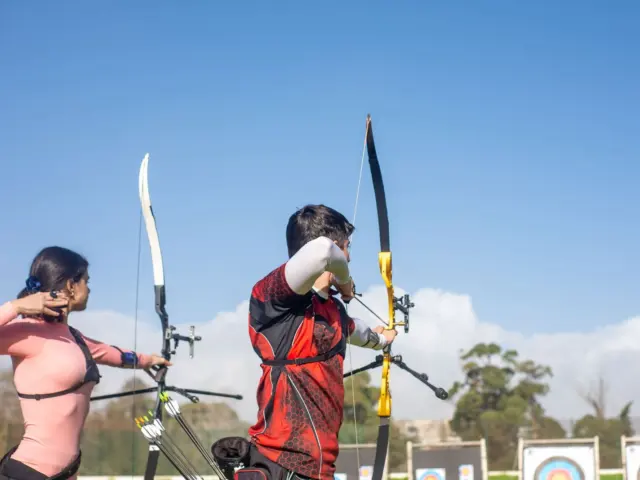
Target archery means shooting at stationary circular targets at a fixed distance. World Archery calls it the most widely known discipline because it is on the programme of the Olympic Games, Paralympic Games and World Games, as the disciplines page explains.
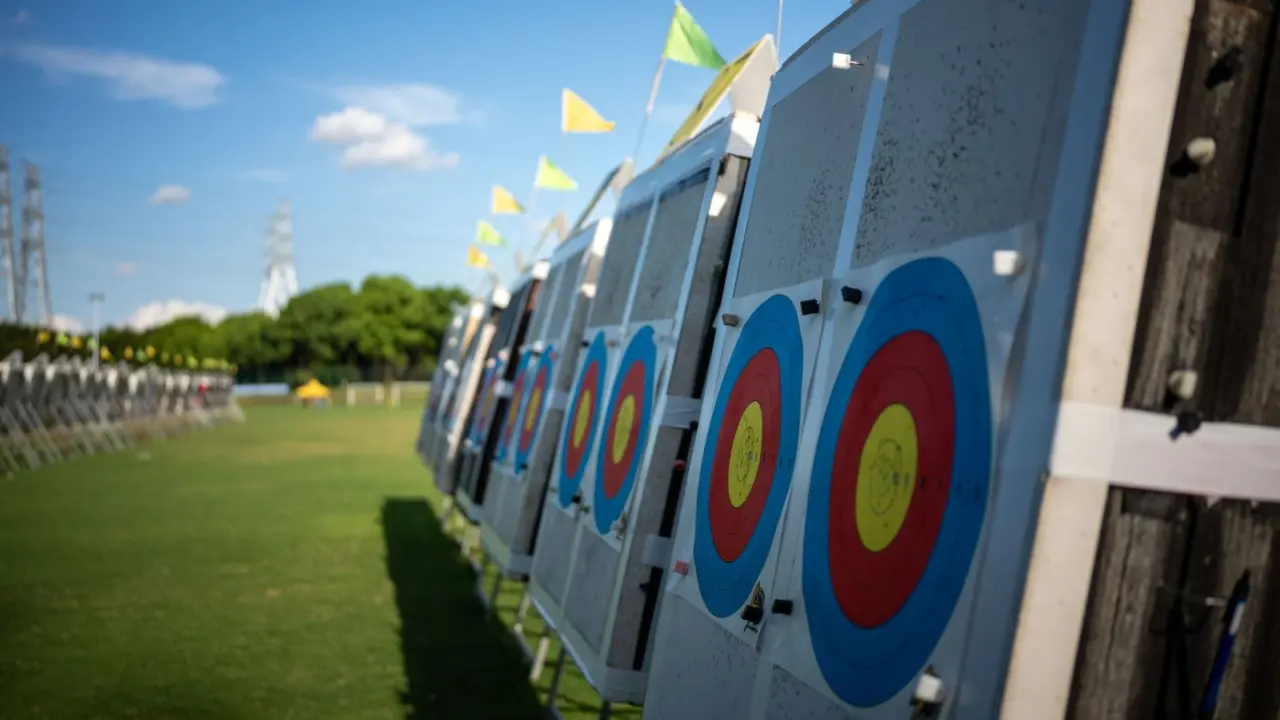
At international events, rounds use the yellow, red, blue, black and white target. Recurve archers shoot at 70 metres and compound archers at 50 metres. Other recognised formats, like the 1440 Round, use distances of 90, 70, 60, 50 and 30 metres, according to the same World Archery page.
Scoring follows a simple pattern, as Wikipedia’s summary of modern competitive archery describes:
- Archers shoot in ends of 3 or 6 arrows, then walk to the target to score and retrieve them.
- Time limits apply: 3 arrows are shot in 2 minutes, and 6 in 4 minutes.
- Rings are worth 1 through 10 points, and outdoors the inner X ring acts as a tiebreaker.
- An arrow just touching a scoring line is awarded the higher score.
The history is long. The earliest known target competition took place in Finsbury Park, Great Britain, in 1583, according to World Archery.
The World Archery Championships were first held in 1931 and take place every two years. The Archery World Cup is the annual circuit for national teams, and its outdoor season usually lasts from April to September.
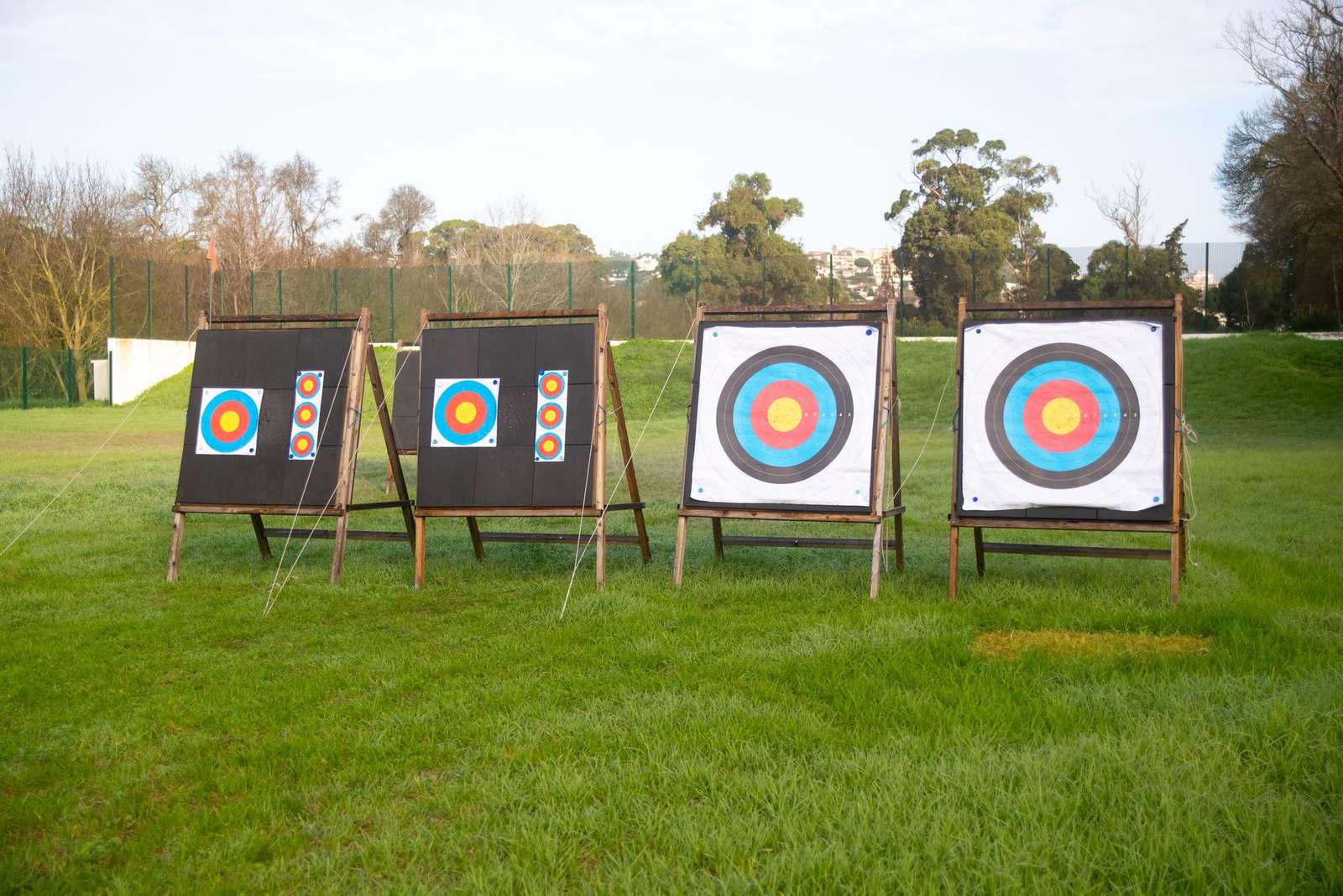
Indoor archery: the same sport, shorter lines
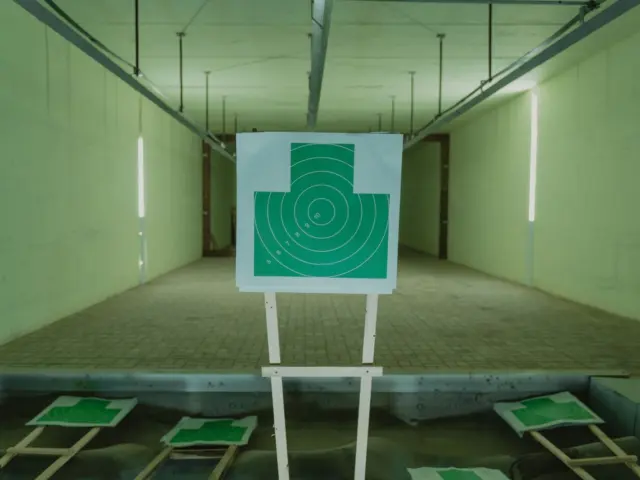
Indoor archery is target archery practised indoors, using smaller versions of the same coloured target. The distance is typically 18 metres for both recurve and compound archers, and other recognised formats are shot over 25 metres. The indoor season usually lasts from October to March, per the disciplines page.
Target faces differ between rounds. Wikipedia notes that they range from 40 cm for the 18 m indoor round up to 122 cm for 70 m.
World Archery organised 14 editions of its indoor world championships from 1991 to 2018. The event was then removed from the international calendar in favour of the Indoor Archery World Series, an annual mass-participation circuit open to all archers, according to World Archery.
Field and 3D archery: shooting around a course
Field archery sends you around a course of stationary circular targets in different sizes, set at varying distances, heights and angles. International rounds use a yellow and black target at distances between 5 and 60 metres for recurve, compound and barebow archers. Distances can be marked (known) or unmarked (unknown), says the World Archery disciplines page.
The World Archery Field Championships take place every two years and were first held in 1969. A fuller walk-through of courses and gear is in the guide to field archery.
3D archery uses stationary foam targets shaped like animals, also set at varying distances, heights and angles around a course. Its world championships were first held in 2003, according to World Archery.
Wikipedia adds that, unlike field archery, 3D distances are almost always unknown. You also need to hit specific scoring points that are less visible than concentric rings.
How does a field or 3D tournament run?
The World Archery Field and 3D competition guide (version 1.0, 11 July 2018) explains the format it introduced for international events. It is not a rulebook, so check the current rules before you enter anything.
According to that guide, the format works like this:
- Tournaments have two days of qualification, followed by two days of individual and team eliminations.
- Qualification is two 24-target rounds: one unmarked and one marked for field, and two unmarked for 3D.
- Elimination matches use a shoot-up format with six targets, marked for field and unmarked for 3D.
- Semifinal and final field matches use four marked targets.
- In field elimination and finals, each athlete has two minutes to shoot three arrows at each target.
- In 3D elimination matches, athletes have one minute to shoot one arrow at each target.
Seeding rewards a strong qualification. The top two seeded athletes advance directly to the semifinals, and the remaining top 20 athletes go into the elimination phase.
Para, flight, ski and run archery
World Archery also recognises disciplines beyond the big three. Each has its own character:
- Para archery is the discipline of target archery for athletes classified with an impairment. Rounds are identical to target archery for recurve and compound archers, with W1 and visually impaired as additional categories.
- Flight archery means shooting arrows as far as possible with a well-defined set of equipment. The all-time hand-held bow record is 1222 metres, set by the USA’s Don Brown in 1987.
- Ski archery combines cross-country skiing with archery, similar to biathlon.
- Run archery combines cross-country running with archery.
Para archery has featured on the Paralympic programme since the first edition of the Games in 1960. Clout archery and popinjay, whose history dates back to the 1400s, are not recognised in the World Archery Rulebook, as the disciplines page explains.
How to choose a format to try
Match the format to what you enjoy before worrying about equipment. These pointers can help:
- Want a repeatable, measured challenge? Start with outdoor target archery, or shoot indoors at 18 metres in the winter months.
- Prefer walking and judging terrain? Try field or 3D archery.
- Have an impairment? Para archery uses the same rounds as target archery, with extra categories.
- Curious about something unusual? Look at flight, ski or run archery.
Whichever you pick, read the archery range safety rules so you know the habits every range expects.
World Archery notes that many local and regional variations exist and may be regulated by national federations. A club shoot can therefore differ from the international rules, so check the details of any event you plan to enter. See the disciplines page for the source.
Frequently asked questions
What are the main types of archery competitions?
Show answer
World Archery recognises target, indoor, field, para, 3D, flight, ski and run archery. Target archery is the best known, according to its disciplines page.
How far away is the target in indoor competitions?
Show answer
International indoor rounds are typically shot at 18 metres for both recurve and compound archers. Other recognised formats are shot over 25 metres.
Is 3D archery the same as field archery?
Show answer
Not quite. Field archery uses circular targets at marked or unmarked distances, while 3D uses foam animal targets. In the 2018 guide, field qualification is one marked and one unmarked round, while 3D qualification is two unmarked rounds.
Which discipline is used at the Olympics?
Show answer
As of the 2026 copyright notice on World Archery’s disciplines page, the archery competitions at the Olympic Games and Paralympic Games use the target archery discipline.