Not sure how to choose archery arrows for your traditional bow? Match the spine to your draw weight and arrow length first, then settle material, weight and straightness. Start long and trim to tune.
Arrows are one piece of your kit, and the wider archery equipment overview shows how the rest fits around them.
| Item | Value |
|---|---|
| Where arrow length is measured | From the throat of the nock to the end of the insert |
| Starting length for a traditional shaft | At least 1 inch longer than the finished arrow |
| Trimming step while tuning | 1/4 inch at a time |
| Straightness suggested for accuracy | No more than +/-.003-inch |
| Weight spread within a set | About plus or minus 10 grains makes no difference at 50 yards and under |
These figures come from Gold Tip’s spine selector page and a May 2010 American Hunter article. Manufacturer guidance and opinions can change, so check the source before you rely on them.
Start with your bow’s real draw weight
Every choice flows from the draw weight of your bow at the length you actually draw. The marked weight on the limb is not enough: 3Rivers Archery’s guide says to determine your draw length and the pull weight of your bow at that draw length, because it may differ from the number printed on the bow.
For longbows and recurves, Gold Tip says to establish the draw weight at the length you draw to. Its method is to come to full draw while a friend marks the arrow where it meets the outside of the riser.
Before you open any chart, write down four things:
- Your draw length, found with the marked arrow.
- The bow’s draw weight at that length.
- The point weight you plan to shoot.
- Your intended finished arrow length, measured from the throat of the nock to the end of the insert.
How to choose arrows: which material suits a traditional bow?
3Rivers Archery lists four materials to choose from: wood, carbon, aluminum and fiberglass, each with its own trade-offs (3Rivers Archery). Here is how the main points stack up.
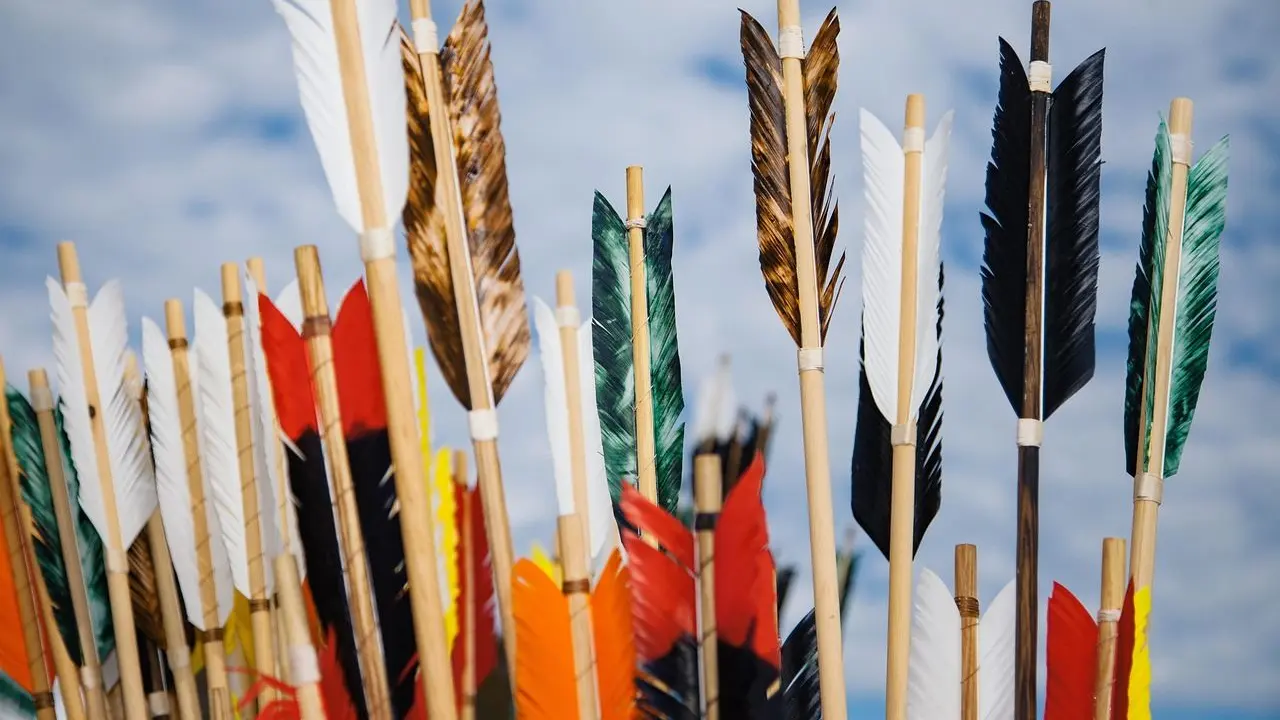
- Wood: the oldest material, and ImproveYourArchery.com notes most traditional archers still shoot it. It is cheap, but it can break or warp, and natural variation makes the flex inconsistent from one shaft to the next.
- Carbon: the same guide calls it light, very durable and very consistent in spine. American Hunter adds that carbon never takes a permanent bend; it flexes but returns to its original straightness.
- Aluminum: American Hunter says aluminum arrows can, and do, bend during the normal course of shooting.
- Fiberglass: cheap and consistent, but sharp splinters when it breaks mean you cannot shorten the shaft yourself and must buy it premade.
If you like the look and feel of wood, expect to sort and sometimes discard shafts that do not match the rest. If you want fewer surprises, carbon is the lower-maintenance route.
Spine: the number that matters most
American Hunter calls spine probably the most important part of the arrow shaft equation. The arrow spine guide on this site goes deeper into charts and numbers, so this section covers the basics only.
Spine is a shaft’s resistance to bending, and the numbering is a common trap. Legend Archery explains that under the AMO/ATA standard a lower number means a stiffer shaft, while the Easton deflection system measures deflection in inches, so a higher number there means a weaker shaft. Always check which system a chart uses.
The same guide lists what shifts the dynamic spine, meaning how the shaft behaves when it is shot:
- Higher draw weight makes the shaft behave weaker.
- A longer shaft flexes more.
- Heavier points increase dynamic flex.
- Release style matters, and fingers on a traditional bow put more side pressure on the arrow.
Traditional shooters have less room for error. Legend Archery points out that off the shelf there is no adjustable rest or button to compensate for a poor spine match, so the shaft carries more of the tuning work.
Gold Tip advises a slightly stiffer shaft if you shoot a broadhead that is longer than your field point. Legend Archery warns against overdoing it, saying one step is usually enough because jumping too many steps stiffer creates its own tuning problems.
Cut long, then tune with bare shafts
For both longbow and recurve, Gold Tip recommends starting with a shaft at least 1 inch longer than your desired finished arrow. You then cut it down 1/4 inch at a time until you reach a good tune using the bare shaft method.
Raw shaft sets are often long. ImproveYourArchery.com says a set is typically 32 inches, which you can cut down to your draw length or use as is.
Treat any chart as a starting point. Legend Archery says spine charts get you close but cannot account for details such as your bow’s brace height, which is why bare-shaft testing reveals what charts cannot.
The same guide suggests that recurve and traditional shooters using fingers start one step weaker than the chart to allow for greater arrow paradox at release. Treat that as a rule of thumb to check against your own bare-shaft results, not a guarantee.
Weight, straightness and the finishing parts
American Hunter’s Bob Robb says arrows fall into three general categories of light, medium and heavy, and each changes trajectory and the kinetic energy delivered to the target. For most North American bowhunting he favors medium-weight arrows as the best mix of trajectory and penetration, which is his view and is aimed at hunting rather than target shooting.
He also says a quiver of arrows within about 10 grains of each other will not affect your shooting at 50 yards and under unless you are one of the very best archers in the world. In other words, match your arrows reasonably, but do not obsess over a few grains.
Straightness is measured in thousandths of an inch, and straighter shafts typically cost more. For most bowhunters seeking maximum accuracy, the same article recommends shafts of no more than +/-.003-inch, and adds that an ultra-straight arrow will not remedy poor form.
Two parts are easy to overlook:
- Nocks: ImproveYourArchery.com says it is very important that the nock measurements work with both your shafts and your string.
- Fletching: the same guide says that in most cases the default fletching is the easiest and best option, and a well-tuned bow should shoot a bare arrow as accurately as a fletched one.
A simple routine for choosing your arrows
Put the advice above in order and the process is short:
- Confirm your draw length and your bow’s draw weight at that length.
- Pick a shaft material that fits your budget and how much sorting and breakage you will accept.
- Find a starting spine on a manufacturer’s chart, then adjust for point weight and for finger shooting.
- Buy shafts a little longer than you need, then trim gradually while you bare-shaft test.
- Check nock fit and straightness, then add fletching.
Before you test any new shafts, read up on how to string a longbow so the bow is set up the same way every session. A consistent setup makes your tuning results easier to trust.
Frequently asked questions
What is the most important arrow spec for a traditional bow?
Show answer
Spine. American Hunter calls it probably the most important part of the shaft equation, and shelf shooters have no adjustable rest to hide a poor match.
Do I have to use carbon arrows?
Show answer
No. Most traditional archers still shoot wood, according to ImproveYourArchery.com, but wood is less consistent and can break or warp. Carbon is lighter, more durable and more consistent in spine.
How can I tell my spine is wrong?
Show answer
Legend Archery lists fishtailing in flight and contact marks on your rest or riser as signs. It calls bare-shaft testing the most reliable diagnostic method.
Does fletching matter much?
Show answer
Less than spine. ImproveYourArchery.com says a well-tuned bow should shoot a bare arrow as accurately as a fletched one, so the default fletching is usually fine.
Will straighter arrows fix my groups?
Show answer
Not by themselves. American Hunter says an ultra-straight, professional grade arrow will not remedy poor form or replace consistency with your bow.